
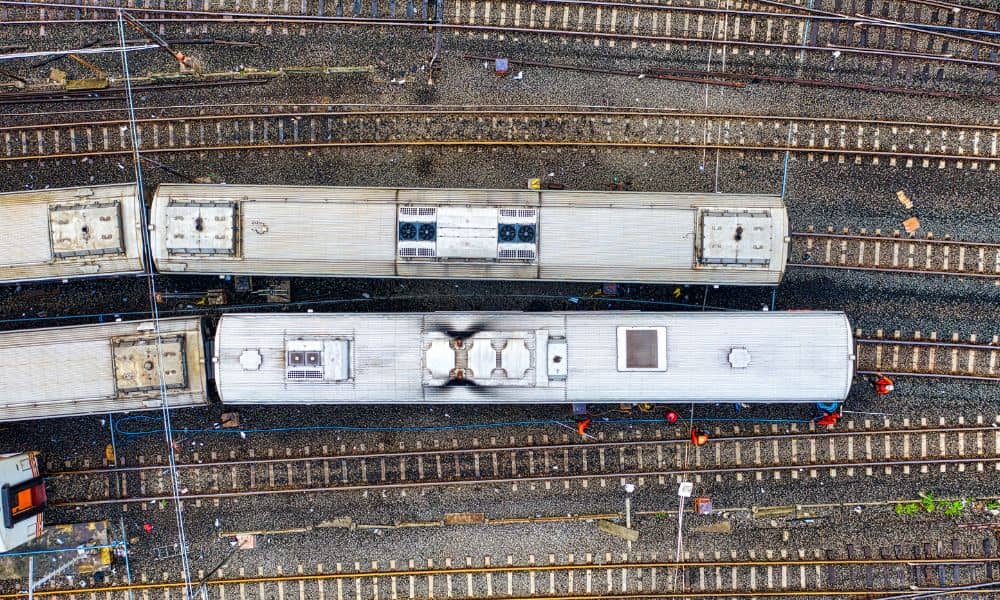
Chicago just got a major transit shake-up. Illinois recently passed a law that boosts long-term funding and reshapes how CTA, Metra, and Pace work together under a new regional structure. That news sounds political at first. However, it quickly turns into something very local: planning, design, and construction will ramp up across corridors, stations, bridges, and streets. And right near the start of that work, teams often lean on an aerial survey to see the full picture fast.
If you build, design, manage, or fund projects near transit, this matters. Even if you just own property near a station, it still matters. An aerial view can reveal problems early—before crews spend weeks walking every block.
Why transit expansion needs “big-picture” mapping first
Transit projects stretch across long routes. They cut through busy intersections. They cross rail lines, alleys, bridges, and tight station areas. So, teams need answers that street-level work can’t always give quickly.
Street crews do great work. They measure tight details, set control, and verify what the design must match. Still, street-level work moves at street-level speed. It also runs into real limits:
- Traffic never stops for long.
- Access rules tighten near tracks and stations.
- Some areas stay fenced or hard to reach.
- One blocked sidewalk can ruin a day’s plan.
Because of that, project teams often start with an aerial survey to gather consistent, corridor-wide data in a short window. Then they use ground crews to verify, tie in, and finish the critical details.
What street-level crews often miss (until later)
Street-level work shows you what sits right in front of you. However, it doesn’t always show how everything connects. That’s where aerial mapping shines.
1) The “whole corridor” story, not just one block
A transit upgrade rarely happens at one point. It usually links station areas, intersections, sidewalks, and utility zones across many blocks. An aerial survey shows continuity. So, designers can spot mismatched curb lines, shifted sidewalks, or tight pinch points long before layout begins.
2) Encroachments that creep into the public space
In Chicago, property edges near transit can get messy. Fences drift. Planters appear. Signs, stairs, and loading zones push out over time. From the ground, a crew can miss patterns. From above, those patterns jump out quickly. As a result, the team can flag conflicts early and avoid ugly surprises during permitting.
3) Drainage behavior you can’t feel in a single visit
Water tells the truth. Yet you need the right view to read it. With an aerial dataset, engineers can study slopes across a wide area and understand how water moves toward inlets, underpasses, or low station approaches. That matters because transit projects often include ADA paths, ramps, and platform access. If water pools at the wrong spot, the project will fight complaints forever.
4) “Hidden” constraints around access and safety
Some areas stay tough to reach on foot, especially near rail-adjacent zones, embankments, and fenced utility corridors. Street crews still cover what they can, but access windows stay limited. An aerial survey helps teams plan smarter field visits. So, they spend ground time on the hardest, highest-risk details—not on broad coverage.
5) Construction staging reality
Transit work needs staging: where trucks park, where crews store materials, where closures can happen, and where pedestrians can still pass. From above, teams can test staging options fast. That reduces redesign later. It also helps owners and contractors argue less.
What an aerial survey actually gives a project team
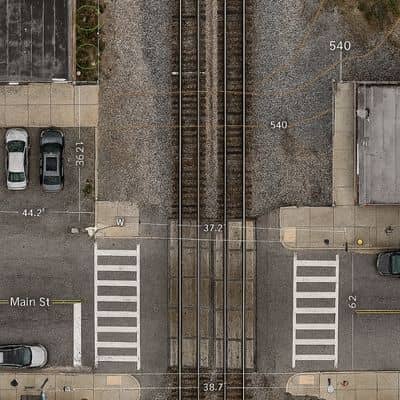
When people hear “aerial,” they picture a pretty photo. You can get a great image. Still, project teams want usable data, not just visuals.
An aerial survey can deliver:
- A clean, high-resolution map that designers can reference
- Surface models that help with grading and drainage checks
- 3D data that supports better planning around structures and tight spaces
- Consistent coverage across a corridor, not patchwork notes
Then the project team can share the same base across civil, utilities, architects, and construction. Because everyone starts from one dataset, coordination improves. Also, meetings get faster, since people stop arguing about what exists on site.
How this helps real clients (not just engineers)
Let’s make it practical. If you handle projects near transit, you probably care about three things: cost, schedule, and risk. An aerial survey can hit all three.
It cuts to “we didn’t know that was there” moments. Every project has them. However, transit corridors produce more of them because the environment changes fast and access stays limited. A wide-area aerial view reduces blind spots early.
It speeds up early design and budgeting. Owners hate guesswork. Yet early budgets often rely on rough base maps. With aerial data, teams can measure lengths, areas, and constraints more confidently. So, cost plans start closer to reality.
It reduces redesign during permitting. Permitting teams and reviewers want clarity. They want to see how work affects sidewalks, access routes, and intersections. When the base mapping stays consistent, the plan set looks cleaner. As a result, the project can move with fewer rounds of corrections.
It helps communication with the public. Chicago residents pay attention when work hits their streets. Visuals help explain what’s coming. Aerial outputs can support clear exhibits for meetings and notices. That builds trust, which helps the schedule.
Three Chicago transit situations where aerial survey pays off
Chicago will likely see more planning activity tied to transit modernization and corridor work. In that setting, aerial survey fits especially well in three common cases:
Station areas and approaches: Teams need clear views of sidewalks, crosswalks, ramps, bus zones, and surrounding geometry. Aerial coverage helps them connect those pieces.
Corridor upgrades and intersection work: Signal work, lane changes, and access adjustments depend on geometry. Aerial mapping helps show how the corridor behaves as one system.
Rail-adjacent improvements: Access can get tricky near tracks. Aerial data helps teams plan field time better and reduce time spent waiting on access windows.
A quick truth: aerial survey doesn’t replace ground verification
Aerial survey provides a powerful start. Still, every serious project needs ground checks, control, and smart verification. Think of it like this: aerial mapping gives you speed and context, while ground work gives you precision and proof. When teams combine both, they move faster and fight less.
A simple next step for prospective clients in Chicago
If you plan a project near a station, a rail corridor, or a major transit route, consider an aerial survey early—before full design, before heavy permitting, and before construction planning locks in. That early clarity can save weeks later.
And if you already have a project moving, you can still use aerial data to tighten the plan, reduce risk, and communicate clearly with stakeholders. In a city as complex as Chicago, seeing the whole corridor first often makes the difference between a smooth build and a stressful one.
