If you’ve asked for LiDAR pricing recently, you may have noticed higher quotes than before. Many property owners, developers, engineers, and city teams across the state are seeing this change. So, what’s behind it? Across many projects, lidar mapping Illinois services now cost more than they did a few years ago. While inflation plays a role, it is not the main reason. Instead, several changes in technology, data handling, labor, and project needs are pushing prices upward.
Growing Demand for Accurate Mapping
First, the demand for LiDAR data has grown quickly across Illinois. New construction, road projects, flood control efforts, and city planning all rely on accurate land data. Because of this, LiDAR has become a standard tool instead of a special service.
As more industries use LiDAR, mapping teams stay busy. When schedules fill up, prices naturally rise. At the same time, many projects now need faster results. Rush jobs require extra staff and computing power, which also increases cost.
In addition, clients now expect higher accuracy than before. Older surveys once worked well enough. Today, engineers and designers need very detailed models to guide planning and construction. This higher level of detail adds time, labor, and cost.
Data Storage Is Now a Big Cost Factor
LiDAR does not create a simple map. Instead, it collects millions of data points that form large files. A single project may include raw scans, cleaned data, surface models, and final deliverables. Secure backup copies must also be stored.
Because these files are so large, storage costs keep rising. Cloud storage, secure servers, and backup systems all add expense. On top of that, companies must protect client data, which requires stronger security systems.
For clients, this means part of the project price now covers safe data storage and management. Although you may not see this work, it plays a key role in protecting your project information.
Data Processing Takes More Time and Skill
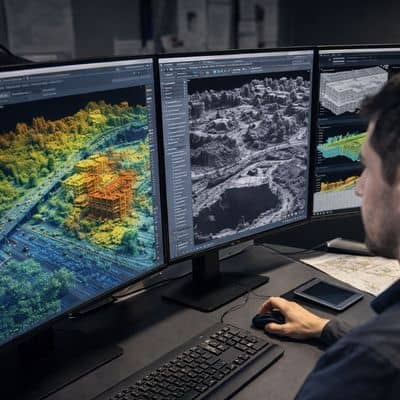
Flying a drone or aircraft to collect data often takes only a few hours or days. However, the real work starts afterward.
Technicians must sort, clean, and organize millions of data points. They build surfaces, remove errors, and check accuracy. This process requires experience, focus, and strong computer systems.
Many projects also need several types of outputs, such as CAD files, contour maps, and surface models. Each format requires extra processing steps. As a result, what once took a short time now requires more effort and care.
Because of this, processing now makes up the largest part of project cost.
Equipment and Insurance Costs Continue to Rise
Modern LiDAR systems rely on advanced sensors, drones, and aircraft. These tools require regular care, updates, and repairs. Over time, equipment costs keep increasing.
Insurance also adds to expenses. Flying drones and aircraft carries risk, especially near buildings, roads, and construction sites. Providers must carry strong insurance coverage to protect everyone involved.
In addition, safety rules and training programs continue to expand. These steps protect workers and the public, but they also add to operating costs.
Skilled Workers Are in High Demand
LiDAR processing requires trained professionals. These workers must understand mapping, engineering, and software systems. Because these skills take time to develop, experienced technicians are in short supply.
As demand grows, wages rise. Companies also invest in training to keep teams up to date. These labor costs play a big role in overall pricing.
While higher wages raise project costs, skilled workers help ensure data quality. Their expertise reduces errors and prevents costly mistakes later.
Project Scopes Keep Expanding
Today’s projects often require more data and more deliverables than before. Clients may request high-density scans, multiple surface models, and various file formats.
In addition, large projects involve many teams. Engineers, planners, and contractors may each need different outputs. Every added request increases processing time and labor.
Without clear planning, project scopes can grow quickly, which leads to higher final costs.
Why Low-Cost LiDAR Can End Up Costing More
Cheaper LiDAR services may look appealing at first. However, poor data quality often leads to problems.
Inaccurate surfaces can cause drainage issues. Missing details may create design errors. Low-density scans may fail to show small changes in terrain.
These problems can delay construction and force redesigns. In many cases, teams must pay for extra surveys or data fixes. As a result, total costs increase far beyond the original budget.
High-quality LiDAR helps avoid these issues. Accurate data leads to smoother designs, safer construction, and fewer delays.
How to Manage LiDAR Costs Without Losing Accuracy
Smart planning helps control project costs. First, define how the data will be used. Design work may need higher accuracy than early planning studies.
Next, choose the right level of detail. Not every project needs maximum point density. Selecting the right level helps balance accuracy and cost.
Also, limit deliverables to what your team truly needs. Extra files add time and expense. Finally, plan schedules early. Flexible timelines allow providers to manage resources better and avoid rush charges.
Working with experienced Illinois providers also helps. Their local knowledge improves efficiency and accuracy.
What This Means for Illinois Projects
The recent price increase reflects real changes in the LiDAR industry. Larger data sets, higher accuracy demands, skilled labor shortages, and rising operating costs all shape pricing today.
Although prices are higher, quality lidar mapping Illinois services deliver better results. Accurate data reduces risk, improves designs, and keeps projects on track.
By understanding these cost drivers and planning wisely, Illinois project teams can continue to benefit from LiDAR while keeping budgets under control.