An aerial survey using drones gives project teams a faster way to understand site conditions before work begins. In a dense city like Chicago, where space is limited and activity is constant, this approach helps reduce unnecessary movement across active areas. Many professionals still refer to this method as a drone survey, but its value goes beyond the name—it provides a clearer, safer view of the site from the very start.
That does not mean drones replace land surveyors. It means they give surveyors another tool to collect visual and spatial data in places where time, access, and safety all matter. On a tight urban site, that can make planning smoother and fieldwork safer.
Why dense urban sites create more survey risk
Chicago projects rarely start on wide open land. Many begin on infill lots, redevelopment parcels, corner properties, or sites boxed in by sidewalks, alleys, fences, and nearby buildings. Even before construction begins, the site can present hazards. Uneven ground, debris, blind spots, and vehicle movement all raise the risk for field crews.
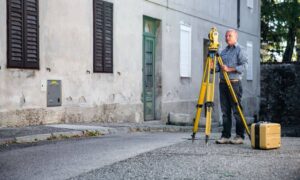
Traditional field surveying still plays a vital role, but it can require repeated movement across the property to document changing conditions. On a cramped site, every extra trip can create more exposure. Teams may need to work near entrances, loading areas, or places where visibility changes fast.
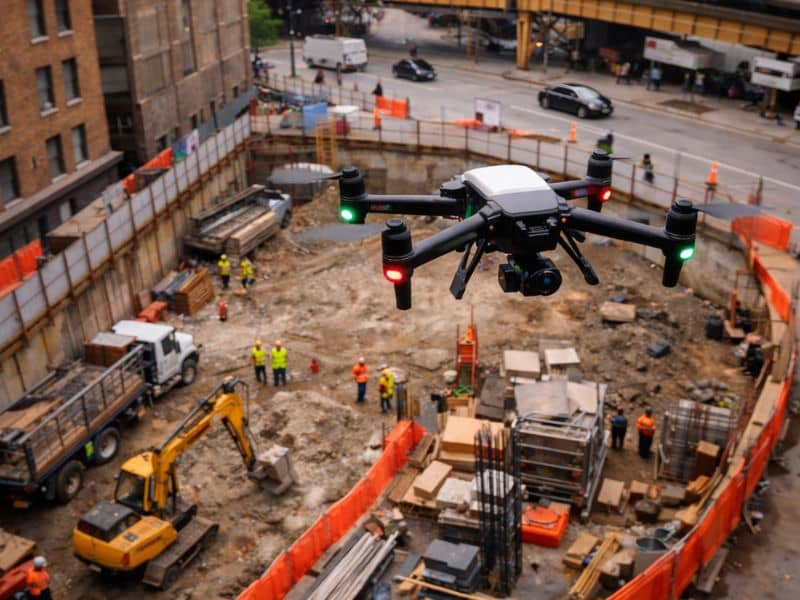
That is where a drone survey helps. It can capture a broad view of the site from above, giving surveyors, engineers, and contractors a shared picture of what is there right now. Instead of relying only on notes from ground level, teams can review up-to-date imagery and identify issues early.
How a drone survey reduces boots-on-the-ground exposure
The biggest safety advantage is simple: fewer unnecessary walks across the site. A drone can document surface conditions, stockpile locations, access paths, drainage patterns, and work staging areas in a short flight. That gives teams useful information before more people step into active zones.
This is especially helpful when the site includes tight setbacks or areas that are hard to reach without crossing hazards. A drone survey lets the survey team inspect conditions from above and focus ground work where precision points are truly needed. That can reduce wasted motion and improve field efficiency.
It also helps project managers see how a site actually functions day to day. A map or legal description will not show the temporary fencing, parked equipment, or material stacks that affect safe movement. Current aerial data can.
A drone survey is also useful when site conditions change quickly. On busy projects, access routes and staging plans can shift from week to week. Updated aerial coverage helps teams track those changes without relying on memory or scattered phone photos.
Where drone data helps crews make faster decisions
On a dense Chicago site, delays often come from limited visibility. One team may not see the same conditions as another, especially when access is tight or the layout changes quickly. An aerial survey using drones helps solve that by giving everyone a shared, up-to-date view of the site.
This is where construction site aerial mapping becomes especially useful. Instead of relying on ground observations alone, teams can review accurate visual data that shows how the site is actually being used. That includes material staging areas, access routes, and any constraints that could affect movement or safety.
With this level of visibility, crews can make better decisions early. They can adjust layouts, plan safer paths for equipment, and avoid conflicts before they happen. It also helps project managers keep work organized without slowing things down or adding unnecessary site traffic.
When everyone is working from the same current data, coordination improves. And on a tight urban site, that often means fewer delays, fewer surprises, and a safer work environment overall.
What Chicago teams need to know before flying
Commercial drone work in the United States falls under FAA Part 107. The FAA says commercial operators may fly at night and over people or moving vehicles only when they meet the rule’s conditions, and airspace authorizations are still required for controlled airspace operations under 400 feet. The FAA also requires compliance with Remote ID for drones that must be registered.
In Chicago, the city states that it does not issue permits that are specific to drone operations, but operators still need to follow key safety requirements. For filming-related activity with high-impact logistics such as drones, the Chicago Film Office says added review time may be required, with a minimum of 10 full business days in some cases.
For survey clients, the takeaway is practical. Do not assume a drone can launch anywhere on short notice just because the site is private. Urban airspace, event restrictions, nearby infrastructure, and project logistics can all affect timing. A qualified survey team plans for that before field day.
Why local survey judgment still matters
A drone survey is powerful, but it is not a shortcut around professional judgment. It works best when a licensed survey team knows what the project needs and how to combine aerial data with ground control, boundary evidence, topographic detail, and site conditions.
That matters in Chicago because no two urban sites behave the same way. One lot may have easy roofline clearance but poor alley access. Another may have clear ground access but airspace constraints or tight neighboring setbacks. The right survey approach depends on the property, the project stage, and the decisions the client needs to make.
In many cases, the smartest path is a blended one. The drone captures fast aerial context. The field crew verifies the critical points on the ground. Together, that creates a clearer and safer picture of the site.
For owners, developers, and contractors, the value is not just in getting images from above. The value is in making better decisions with less guesswork. On a tight Chicago site, that can mean safer movement, better coordination, and fewer surprises once work begins.
A drone survey will not solve every site problem. But when space is limited and visibility matters, it can give the team a smarter starting point. That is why more urban projects use it early, before risk spreads through the rest of the job.