How To Find Your Property On FEMA’s Flood Insurance Rate Maps

What are FEMA flood maps?
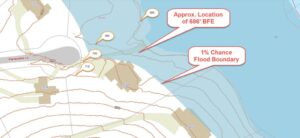
FEMA’s Flood Insurance Rate Maps (FIRMs) or just Flood Maps are provided after a flood risk assessment has been completed or updated for a community.  This study is known as a Flood Insurance Study.  The FIRM gives you the Base Flood Elevations (BFEs) and insurance risk zones in addition to floodplain boundaries.  The FIRM may also show a delineation of the regulatory floodway.

Once the “insurance risk zone”  (commonly referred to as the flood zone) is determined, actuarial rates, based on these risk zones, are then applied for newly constructed, substantially approved, and substantially damaged buildings.  FEMA uses these rates to determine the insurance rate you will pay for flood insurance

FEMA’s Digital Flood Maps

FEMA discontinued the production and distribution of paper flood maps in 2009 as part of its Digital Vision Initiative. This affected all the Flood Maps, boundary information, and study reports. However, clients can still view the products for free through their website or buy them in digital format.

To view these flood maps online, go to FEMA’s Map Service Center and key in your address (hi-lited area shown here) search for your home.  This will prompt you to then select the map that covers your area.  The Flood Maps are somewhat cumbersome to use online. It is best to go through the tutorial on the bottom right of the address search page for an easier and more effective use of the GIS map.

author avatar
Surveyor

More Posts

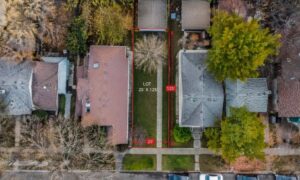
Aerial view of a narrow residential lot with boundary lines showing how surveying companies help define property limits in tight city spaces
land surveying
Surveyor

Building on a Small Lot? Call Surveying Companies Early

Chicago is changing fast. New homes, coach houses, and small multi-unit buildings are showing up in older neighborhoods. A big reason for this is infill development. Instead of building far out, people are building on existing lots inside the city. Many of these lots are 25 or 50 feet wide.

Read More »
Aerial view of a residential property with a rear alley showing how an ALTA survey reveals access and layout limitations
alta survey
Surveyor

ALTA Survey: Catch Access Issues Before You Build

A buyer picks up a small property in Chicago. The lot looks fine. There’s a rear alley. Cars pass through, trash gets picked up, and nothing feels off. So the project moves forward. Plans get drawn. Parking gets laid out. The timeline starts to take shape. Then during review, something

Read More »

How a Drone Survey Makes Tight Job Sites Safer

An aerial survey using drones gives project teams a faster way to understand site conditions before work begins. In a dense city like Chicago, where space is limited and activity is constant, this approach helps reduce unnecessary movement across active areas. Many professionals still refer to this method as a

Read More »
Surveyor performing a construction survey to mark site layout before work begins
land surveying
Surveyor

Why a Construction Survey Matters Before Work Begins

Big projects do not always move in a straight line. In Chicago, recent transit delays have made that clear. Work can slow down when funding shifts or plans change. But even when everything pauses, the ground does not. The site keeps changing every day, which is why getting the site

Read More »
Water pooling on a driveway after a storm, showing drainage issues that an elevation survey can help identify
flood damage
Surveyor

What to Do After a Storm: Elevation Survey Guide

The March storm that swept through Chicago came down hard and fast. Streets filled with water, yards turned soft, and many homeowners saw water where it had never been before. At first, the focus is always on cleaning up. You check for damage, move things around, and think about repairs.

Read More »
Land surveyor measuring a residential property line to complete a property line survey before building near a fence
boundary surveying
Surveyor

Property Line Survey: Avoid Boundary Mistakes When Building

Homeowners often look for ways to improve their property. Some want a new fence for privacy. Others plan to add a shed, rebuild a garage, or widen the driveway. These upgrades can make a home more useful and more comfortable. However, many people forget one important step before building near

Read More »