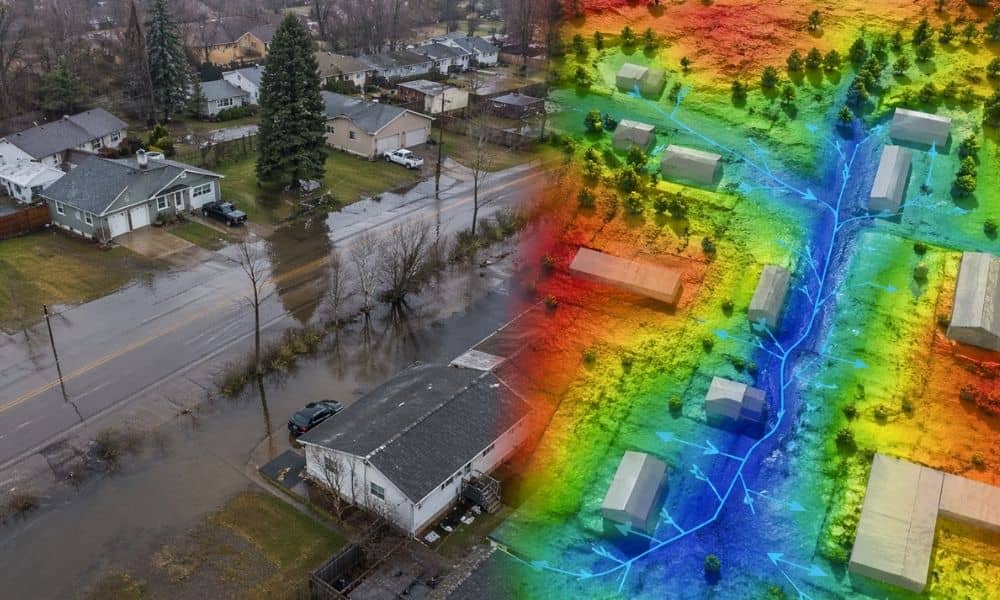
Heavy rain hit the Chicago area again this week. Streets filled up fast. Some homes saw water creep closer than expected. For many people, it felt sudden.
But the truth is simple. Most of these problems were already there.
Water just exposed them.
Many properties in Chicago look flat. They seem safe. You walk the site, and nothing stands out. Then a strong storm hits, and water starts pooling in places no one expected.
That’s where lidar mapping comes in. It shows what your eyes can’t.
What This Week’s Flooding Shows About Chicago Properties
Flooding in cities like Chicago rarely comes from rain alone. The real issue often sits at ground level.
A few inches of slope can change everything. Water follows the path of least resistance. If a surface tilts the wrong way, even slightly, water will move toward structures, not away from them.
That’s why some driveways flood while others stay dry. It’s why one lot drains well while the one next door holds water.
During dry days, these problems stay hidden. After heavy rain, they show up fast.
The Drainage Risks You Won’t Catch by Walking the Site
A simple site visit won’t reveal much. Most drainage issues hide in small elevation changes.
Here are a few common ones seen across Chicago properties:
A slight dip near a foundation can collect water over time. It might look level, but it isn’t.
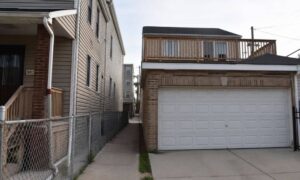
Two buildings close together can create a low channel. Water flows between them and pools at the back.
An alley may slope just enough to push runoff toward your property.
Older grading work may have shifted. Years of small changes can redirect water without anyone noticing.
Neighboring lots can also send water your way. If their elevation sits higher, runoff will move downhill, straight into your space.
These are not obvious problems. You won’t spot them by standing on the ground and looking around.
How LiDAR Mapping Finds These Hidden Issues
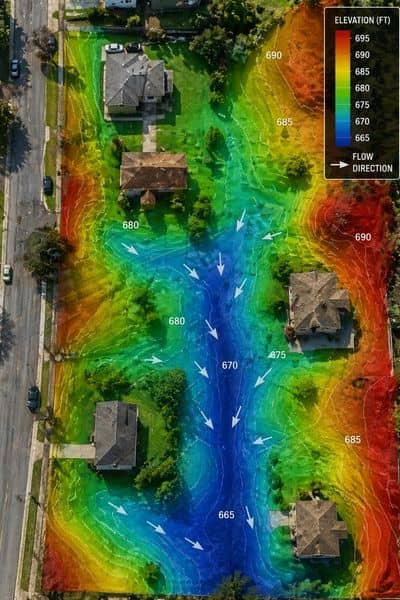
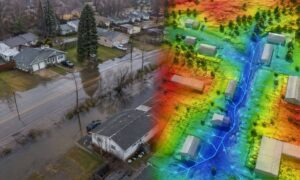
Lidar mapping measures elevation with a high level of detail. It picks up small changes across a surface, even the ones you can’t see.
So instead of guessing how water might move, you can actually see how the ground is shaped.
You can spot where the land dips. You can follow how water travels across a site. You can also find areas where runoff slows down or starts to collect. That’s how lidar mapping helps catch drainage issues early, even on properties that seem flat at first glance.
For properties dealing with these issues, lidar mapping for hidden drainage problems makes it easier to see what’s really going on below the surface.
That level of detail matters. Even a one-inch change can push water toward a building.
With lidar mapping, those small shifts are easier to read, so decisions are based on real conditions, not guesswork.
Why Standard Checks Miss the Problem
Many property owners rely on basic inspections. They walk the site. They look for obvious signs. That works for large issues, but not for subtle ones.
Even existing plans may not help much. Some rely on older data. Others smooth out small changes that actually matter for drainage.
In tight urban spaces, things get even more complex. Surfaces connect in ways that are hard to read without detailed mapping.
A driveway connects to a sidewalk. The sidewalk meets the street. Each point has its own slope. Together, they form a path for water.
Without lidar mapping, those connections stay unclear.
Why This Matters Before You Build or Buy
Drainage problems don’t stay small. They turn into repairs, delays, and complaints.
A new project might need changes after construction starts. That slows everything down.
Water pooling near a structure can lead to long-term damage. That affects both safety and value.
In some cases, runoff can impact nearby properties. That creates conflict and added cost.
Planning ahead helps avoid all of that.
With lidar mapping, you can study the site before work begins. You can adjust grading early. You can design with water flow in mind.
That saves time. It saves money. It also prevents stress later on.
Where This Happens Most in Chicago
Chicago has many areas where these issues show up often.
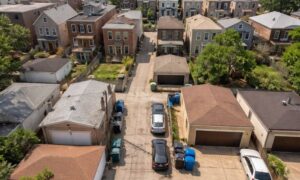
Dense neighborhoods with tight spacing between homes can trap water in narrow gaps.
Older properties may have uneven surfaces from past work.
Infill projects often deal with limited space and mixed elevations.
Some areas also sit closer to rivers or low-lying zones. That adds pressure during heavy rain.
All of these conditions increase the chance of hidden drainage problems.
When to Consider LiDAR Mapping
Timing matters. The best time to use lidar mapping is before problems start.
It makes sense before buying a property. You want to know how water behaves on that land.
It also helps before design begins. That way, you can plan grading with real data.
During redevelopment, it gives a clear view of existing conditions.
If a site has seen flooding before, it becomes even more useful.
Waiting until after damage happens often leads to higher costs and limited options.
Flooding Is a Warning Sign
Recent flooding across Chicago isn’t a one-time event. It shows where the weak spots are.
Water doesn’t create new problems. It reveals the ones already in place.
Many of those problems sit below the surface. You can’t see them during normal conditions.
Lidar mapping brings those hidden details into view. It shows how water moves. It shows where it will collect. It gives you a chance to act early.
For property owners, developers, and builders, that early insight makes a real difference.